Amazon shoppers are no longer limited to typing short keywords into a search bar. With Alexa for Shopping, they can ask detailed questions, compare products, and receive recommendations based on their needs.
For sellers, this means product listings must do more than rank for relevant keywords. They must also give Amazon enough clear and accurate information to understand when a product should be recommended.
In this guide, we explain how Alexa for Shopping is changing product discovery and what sellers can do to prepare their listings for AI-assisted shopping.
Overview
- What Is Alexa for Shopping?
- How does Alexa for Shopping affect Amazon Sellers’ Listings?
- Key Alexa for Shopping Capabilities
- SEO, AEO, and GEO: Why They All Matter
- How to Optimize Your Amazon Listings for AI Shopping
- AI Is Changing Amazon Advertising Too
- Connected Workflows Are the Next Competitive Advantage
- Frequently Asked Questions
- References
What Is Alexa for Shopping?
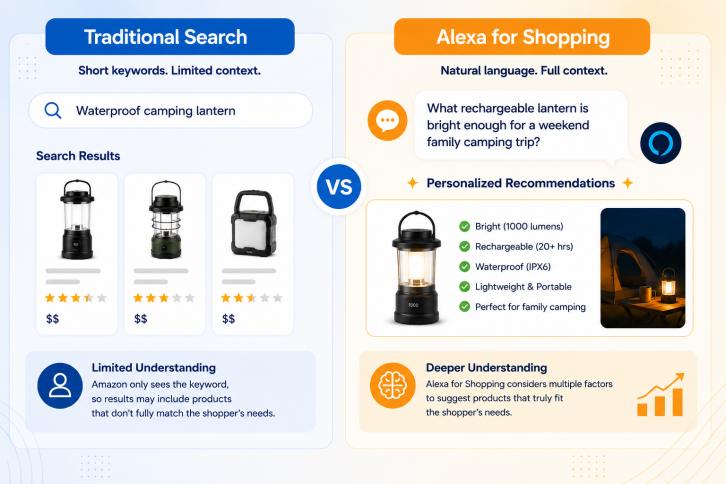
Alexa for Shopping is Amazon’s AI-powered shopping assistant. Formerly known as Rufus, it helps customers discover, compare, and purchase products through natural-language conversations.
Instead of entering a short search such as:
Waterproof camping lantern
A shopper might ask:
“What rechargeable lantern is bright enough for a weekend family camping trip?”
The second search gives Amazon much more information about what the shopper needs. Alexa for Shopping can consider factors such as battery life, brightness, portability, durability, and intended use before suggesting a product.
Did You Know? AI Shopping by the Numbers
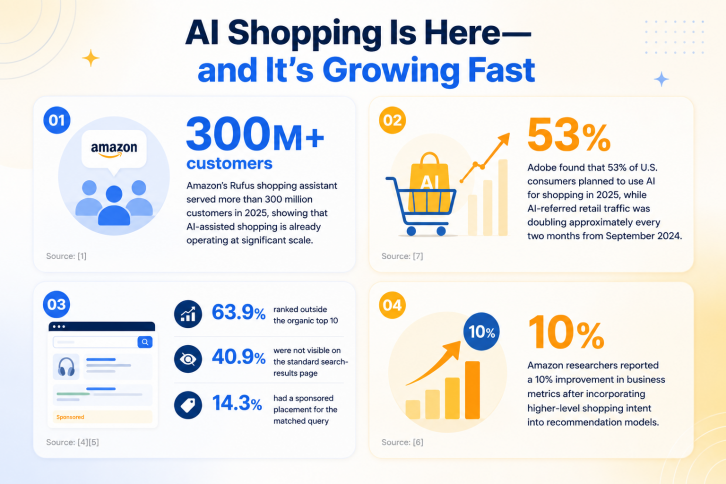
- Amazon’s Rufus shopping assistant served more than 300 million customers in 2025, showing that AI-assisted shopping is already operating at significant scale. [1]
- Adobe found that 53% of U.S. consumers planned to use AI for shopping in 2025, while AI-referred retail traffic was doubling approximately every two months from September 2024. [7]
- A study of 12,810 Alexa recommendations across 1,963 non-branded queries found that 63.9% ranked outside the organic top 10, 40.9% were not visible on the standard search-results page, and only 14.3% had a sponsored placement for the matched query. [4][5]
- Amazon researchers reported a 10% improvement in business metrics after incorporating higher-level shopping intent into recommendation models. [6]
How does Alexa for Shopping affect Amazon Sellers’ Listings?
This changes what makes a strong Amazon listing. Keywords still help Amazon identify and find a product, but they may not provide enough information for its AI to understand when the product is the best recommendation. but they may not provide enough information for its AI to understand when the product is the best recommendation.
For example, a listing that only includes phrases such as:
- rechargeable lantern
- LED lantern
- waterproof lantern
tells Amazon what the product is.
However, a listing that also explains that the lantern:
- lasts up to 20 hours on one charge
- provides enough light for a family campsite
- charges through USB-C
- is suitable for camping, emergency kits, and power outages
gives Amazon more context about who the product is for and when it may be useful.
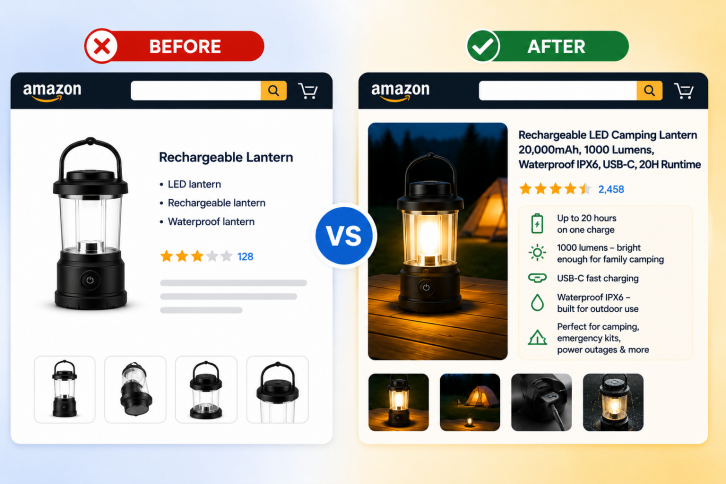
Amazon product discovery is therefore moving beyond simple keyword matching. Sellers should still optimize search visibility, but they should also clearly explain their products’ features, benefits, uses, compatibility, and limitations.
Key Alexa for Shopping Capabilities
| Alexa for Shopping feature | What it does | How sellers should prepare |
|---|---|---|
| Personalized recommendations | Recommends products based on customer preferences, purchase history, and shopping context. | Clearly explain the target audience, product benefits, and intended uses. |
| Product comparisons | Compares similar products using features, prices, ratings, and customer feedback. | Make specifications, benefits, and product differences easy to identify. |
| AI Overviews | Provides summaries in search results to help customers understand product categories and options. | Add clear specifications, compatibility details, use cases, and educational content. |
| Price tracking and alerts | Monitors prices and notifies shoppers when a product reaches their preferred price. | Maintain competitive pricing and respond to meaningful market changes. |
| Shopping memory | Remembers previous shopping conversations and preferences across devices. | Keep product information accurate and consistent throughout the listing. |
| Buy for Me | Can complete purchases from participating brand websites when an item is unavailable on Amazon. | Make product information complete, reliable, and easy for AI systems to verify. |
SEO, AEO, and GEO: Why They All Matter
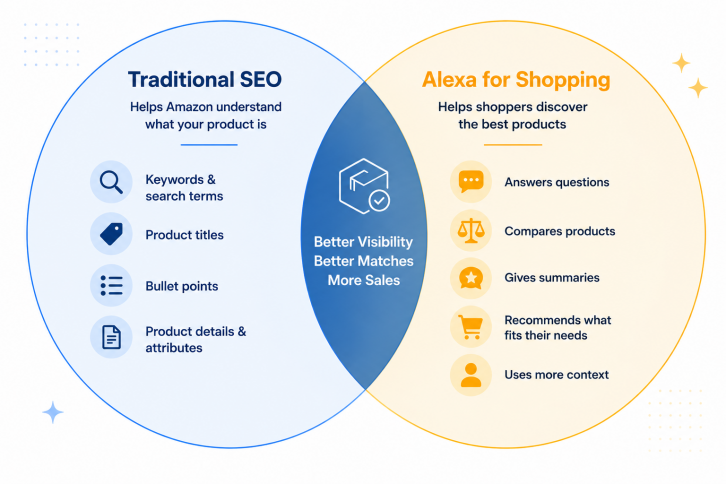
As AI tools become more popular, some people wonder if regular SEO still matters. The answer is yes. This is also true for sellers on Amazon.
Amazon still looks at the words and details in a product listing. These details help Amazon understand what the product is and show it to the right shoppers.
Sellers should make sure their product titles, bullet points, keywords, and other information are clear and correct. and other information are clear and correct.
At the same time, Alexa for Shopping is changing how people shop on Amazon. It can answer questions, compare products, give short summaries, and suggest products that may fit a shopper’s needs.
Because of this, sellers should think about more than keywords. They should also make their listings easy for AI tools to understand.
Amazon says Alexa for Shopping can use information from product listings, customer reviews, questions and answers, other websites, and past conversations.
A good product listing should clearly explain:
- what the product is
- what it does
- who it is for
- when it is useful
- what products or devices it works with
- what it is made from
- its size
- any limits or problems shoppers should know about
- common ways people may use it
Amazon has not shared an exact formula for how Alexa chooses which products to recommend. However, clear and correct information can help both shoppers and AI tools better understand a product.
How to Optimize Your Amazon Listings for AI Shopping
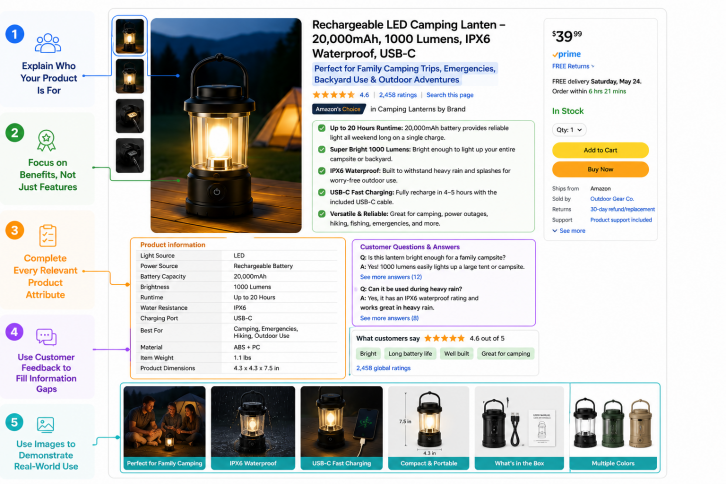
Here are five ways to improve your listings for both traditional search and conversational shopping.
1. Explain Who Your Product Is For
Your listing should clearly identify who the product is designed for and the situations where it performs best.
Instead of describing a product simply as a “rechargeable camping lantern,” explain whether it’s ideal for family camping trips, emergency preparedness, backyard gatherings, or hiking. These details help shoppers make faster decisions while giving Amazon more context for personalized recommendations.
Review your title, bullet points, description, and A+ Content to make sure they answer a simple question: Who should buy this product, and why?
2. Focus on Benefits, Not Just Features
AI shopping assistants are designed to interpret customer intent, so connecting features to real-world outcomes helps Amazon understand when your product is the right recommendation.
For example:
- Feature: 20-hour battery life
- Benefit: Provides reliable lighting throughout a weekend camping trip without frequent recharging.
Similarly, “IPX6 waterproof” means more when paired with “built to withstand heavy rain during outdoor adventures.”
3. Complete Every Relevant Product Attribute
Structured product data plays an important role in helping Amazon categorize and recommend products.
Where possible, complete all relevant attributes, including:
- materials
- dimensions
- compatibility
- power source
- intended use
- indoor or outdoor suitability
- size and capacity
- color and style
These fields may seem unimportant at first because the customer may not see it, but they provide important information for Amazon to complement the info that customers can see in your listing.
Incomplete attributes can make it harder for Amazon to match your listing with detailed customer requests.
4. Use Customer Feedback to Fill Information Gaps
One of the best ways to improve a listing is to look at the questions customers are already asking.
Review sources such as:
- product reviews
- Customer Questions & Answers
- support inquiries
- return reasons
- search term reports
If shoppers repeatedly ask whether a product is compatible with a certain device, suitable for children, or safe for outdoor use, that information probably belongs in the listing.
Likewise, search term reports often reveal the language customers naturally use to describe their needs. Incorporating that language can improve clarity without resorting to keyword stuffing.
5. Use Images to Demonstrate Real-World Use
Images should do more than showcase your product, they should answer customer questions before they’re asked.
Consider including images that show:
- the product in use
- dimensions and scale
- key features
- package contents
- compatible devices or accessories
- common use cases
- material type
- product variations
- close up photos
A good way to tell whether your product images answer customer questions is to review a similar competitor listing.
Ask yourself: What would I have wanted to know from these images that the seller did not show?
AI Is Changing Amazon Advertising Too
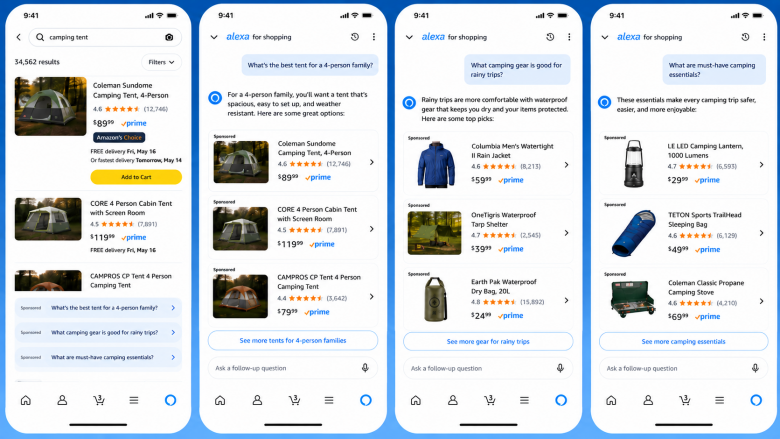
Amazon’s AI is changing more than product discovery; it is also changing how ads are matched to shoppers. Instead of showing ads only in response to keyword searches, Amazon Ads can now display Sponsored Products and Sponsored Brands prompts, which are AI-powered ad extensions to your existing Sponsored Products and Sponsored Brands campaigns. They will be shown across shopping results and Amazon product detail pages; when clicked, these prompts may either launch an Alexa for Shopping dialog or provide a response directly on the page where they appear.
For sellers, this means creating detailed, context-rich listings that clearly explain a product’s features and benefits, helping Amazon’s AI answer potential customer questions more accurately.
Connected Workflows Are the Next Competitive Advantage
A strong listing helps shoppers discover your product, but it’s only one part of the equation. Pricing, advertising, inventory, Featured Offer eligibility, and listing quality all influence one another.
For example, a successful ad campaign can quickly increase sales, but it may also lead to stockouts. Lowering your price may improve conversions, but it can also reduce profit if advertising costs stay high. When these areas are managed separately, it’s easy to miss these connections and react too late.
Connected automation helps bring these moving parts together. Instead of managing advertising and pricing in isolation, sellers can make faster, data-driven decisions across their business.
BQool AI Advertising helps optimize campaigns automatically, while BQool Repricer responds to competitor price changes and helps protect profit margins and buy box ownership. Together, they help sellers align traffic, pricing, and profitability, so every part of the business works toward the same goal.
Frequently Asked Questions
Can Alexa do shopping?
Yes. Alexa for Shopping helps customers discover, compare, and purchase products on Amazon using natural-language conversations. Instead of typing a few keywords into the search bar, shoppers can ask detailed questions, compare products, and receive personalized recommendations based on their needs.
Is Alexa for Shopping the same as Rufus?
Yes. Alexa for Shopping builds on the AI shopping capabilities that were first introduced as Rufus. Amazon has integrated these features into Alexa+, creating a single AI shopping assistant that can answer questions, compare products, and help customers make purchasing decisions.
How should sellers optimize for Alexa for Shopping?
Sellers should go beyond keyword optimization and provide complete, accurate product information. This includes clearly explaining who the product is for, what problem it solves, its key benefits, compatibility, specifications, dimensions, materials, and common use cases. The more context your listing provides, the easier it is for Amazon’s AI to understand when your product is relevant to a shopper’s request.
References
[1] Amazon Ads: What Agentic Shopping Means for Advertising
[2] Amazon: Alexa for Shopping: Amazon’s AI Assistant for Personalized Shopping
[3] Amazon: Amazon Rufus AI Assistant Personalized Shopping Features
[4] Marketplace Pulse: Amazon’s AI Doesn’t Read the Rankings
[5] EcomCrew: Amazon’s AI Recommends Products Your Search Rank Can’t Reach
[6] Amazon Research: Learning to Personalize Recommendation Based on Customers’ Shopping Intents
[7] Adobe Analytics: Traffic to U.S. Retail Websites from Generative AI Sources Jumps 1,200 Percent