Amazon is removing its seller eligibility gate for the Featured Offer, still widely known as the Buy Box. The change started rolling out in July 2026 and is expected to reach all Amazon stores by the end of the year.
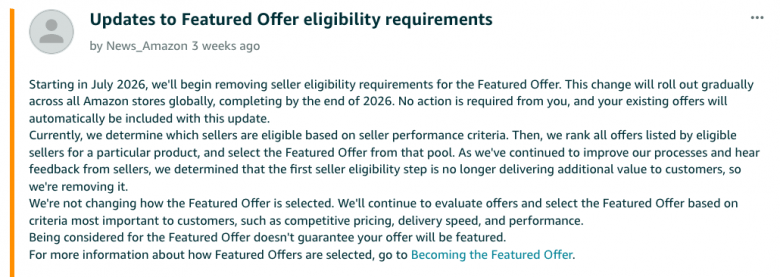
This does not mean every seller will win the Featured Offer. It means every offer can enter the competition. Price, delivery speed, and seller performance will still help determine which offer Amazon features.
Overview
- The 30-Second Summary
- Before the Update: What Made a Seller Eligible?
- What Did Amazon Change?
- What Is Not Changing?
- Why the Change Matters for Pricing
- Why the Change Matters for Amazon Advertising
- Who Could Benefit, and Who Faces More Competition?
- Why Is Amazon Making This Change?
- Sellers Welcome the Opportunity but Question the Details
- Five Actions Sellers Should Take Now
- What Amazon Has Not Explained Yet
- Final Takeaway
- Frequently Asked Questions
The 30-Second Summary
| Before | After |
|---|---|
| Amazon first decided which sellers were eligible. | The separate seller eligibility step is removed. |
| Only offers from eligible sellers entered the ranking process. | Existing offers are automatically considered after the update reaches the store. |
| Amazon then ranked those offers. | Amazon still ranks offers using factors such as price, delivery speed, and performance. |
| Some sellers could not compete at all. | More offers may compete, but consideration does not guarantee placement. |
The simplest way to read the update is this:
Amazon is removing the gate, not the competition.
Before the Update: What Made a Seller Eligible?
Before the rollout, Amazon first evaluated whether a seller was eligible to compete for the Featured Offer. Its published guidance identified several factors:
- A Professional selling plan rather than an Individual plan
- Account performance, including Order Defect Rate, Cancellation Rate, and Late Shipment Rate
- Competitive total price, including shipping
- Product availability
- Fast and reliable shipping
- Customer service quality
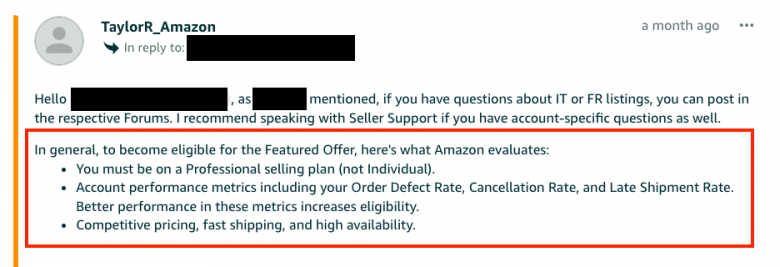
Amazon’s advertising guidance also states that Order Defect Rate should remain below 1%. FBA could improve a seller’s chances by supporting faster delivery and 24/7 customer service, but Amazon did not describe FBA enrollment as a guarantee.
These were not a complete checklist that guaranteed eligibility. Amazon evaluated multiple factors, and sellers with healthy visible metrics could still be found ineligible. The July 2026 update removes this separate seller-level evaluation as it reaches each store. It does not remove price, delivery, availability, or performance from the decision about which offer is featured.
What Did Amazon Change?
Amazon previously used a two-step process:
- It evaluated whether a seller met performance-based eligibility requirements.
- It ranked offers from eligible sellers and selected the Featured Offer.
In its July 6 announcement, Amazon said the first step no longer added value for customers. It is therefore removing that separate eligibility check.
The rollout is not happening everywhere at once:
- US and other Amazon stores: A gradual rollout began in July 2026.
- EU and UK: Amazon set July 20, 2026 as the effective date in its regional announcement.
- Worldwide: Amazon expects the rollout to finish by the end of 2026.
Sellers do not need to enroll or update their offers. Amazon says existing offers will be included automatically when the change reaches each store.
What Is Not Changing?
The update does not remove the factors used to select the Featured Offer.
Amazon says it will continue to evaluate:
- Competitive pricing
- Delivery speed
- Seller performance
Amazon’s current seller guidance also recommends fast and free shipping, a strong customer experience, and reliable stock levels. In other words, a seller with a weak offer does not receive a shortcut to the Buy Box.
The update also does not confirm the end of Featured Offer suppression. Amazon can still decide not to display a Featured Offer when no offer meets its standards, including when it considers a price uncompetitive.
Why the Change Matters for Pricing
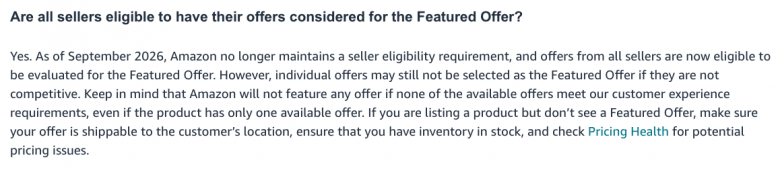
Removing the eligibility gate may increase the number of offers competing on some ASINs. Sellers that were previously excluded for seller-level eligibility reasons may now enter the ranking pool.
That could produce three practical changes:
1. Featured Offer share may move more often
An established seller could face competitors that were not previously considered. The effect will vary by marketplace, category, ASIN, and fulfillment setup because Amazon is rolling out the update gradually.
2. A lower price still does not guarantee a win
Amazon evaluates the total offer, not price alone. A cheaper offer may still lose when another seller provides faster delivery or stronger performance.
Cutting prices without checking margin and fulfillment differences can start an unnecessary price war. Sellers need a response based on competitor behavior, not a rule that always races to the bottom.
3. Historical performance needs a fresh baseline
Past Featured Offer win rates were measured under the old eligibility structure. After the update, a change in win rate could reflect a larger competitive pool rather than a sudden failure in your pricing strategy.
Track Featured Offer win percentage, Featured Offer price, sales, and margin at the ASIN level before making broad changes. BQool Repricing Central can help sellers monitor Buy Box performance and adjust prices within their min and max price as market conditions change.
Why the Change Matters for Amazon Advertising
Featured Offer status and Sponsored Ads are closely connected.
According to Amazon Ads, a product must be eligible for the Featured Offer to advertise with Sponsored Ads. Amazon also advises advertisers to choose products that display the Featured Offer when optimizing campaigns.

The removal of the seller-level gate may allow more offers to become eligible for consideration.
For advertisers, the key risk is simple: traffic and conversion data can change when Featured Offer ownership changes.
Private label sellers should watch for:
- A sudden drop in Sponsored Ads impressions
- Lower conversion rates after a Featured Offer loss
- Higher ACoS caused by weaker retail readiness
- Listings with ad spend but unstable Featured Offer status
Do not respond to every performance change by raising bids. First check price competitiveness, stock, delivery promise, and Featured Offer status. Then adjust advertising.
BQool Advertising can automate bid, keyword, and budget optimization, but campaign decisions still work best when paired with healthy listing fundamentals and regular Featured Offer monitoring.
Who Could Benefit, and Who Faces More Competition?
New and previously ineligible sellers gain a chance to compete
Sellers who could not pass the old eligibility step may have their offers considered after the rollout reaches their store. That is an opportunity, not a guaranteed win.
They will still need a competitive price, dependable delivery, good account performance, and available inventory.
Arbitrage and wholesale sellers may see a larger competitive pool
Resellers often share listings with multiple merchants, so even a small expansion in the ranking pool can affect Featured Offer rotation.
The right response is not automatic undercutting. Compare landed price, fulfillment method, delivery promise, feedback, and inventory position before changing a repricing rule.
Private label sellers may get relief from one eligibility barrier
Brand owners have repeatedly complained that they can lose Featured Offer eligibility even when they are the only seller on an ASIN. Removing the seller-level gate may help in cases caused by that step.
But it may not solve suppression caused by Amazon’s competitive pricing checks. A sole seller can still lose the Featured Offer if Amazon decides the offer itself should not be featured.
FBA and FBM sellers still compete on the full customer offer
Amazon’s July announcement does not say that fulfillment method has stopped mattering. Delivery speed and performance remain selection factors, so fulfillment decisions can still affect the outcome.
Avoid reading the update as proof that FBA and FBM offers will now be treated identically in every situation. Amazon has not published the ranking weights.
Why Is Amazon Making This Change?
Amazon gave one official reason: the separate eligibility step was no longer delivering additional value to customers.
Several broader explanations are possible, but they remain analysis rather than confirmed motives.
A single ranking process may be simpler
If seller performance is already relevant when Amazon compares offers, a separate pass-or-fail step may duplicate part of the evaluation. Removing it could simplify the process while keeping customer-focused factors in the ranking.
Amazon has received seller feedback about eligibility
Amazon directly referred to seller feedback in the EU and UK announcement. Forum discussions show recurring frustration from sellers who did not understand why their offers were ineligible.
Regulatory scrutiny provides important context
In 2022, the European Commission made Amazon’s commitments on equal access to the Buy Box legally binding. This makes competition and non-discrimination relevant background, especially for the EU and UK rollout.
However, Amazon has not publicly said that the July 2026 update was made because of that case. Treating regulation as the confirmed cause would go beyond the available evidence.
Sellers Welcome the Opportunity but Question the Details
The reaction in Amazon’s seller forum is mixed.
Some sellers see the update as common sense. Brand owners asked why they could be ruled ineligible on listings where they were the only seller.
Others are cautious. They want to know whether sellers with weaker service records can now win by offering a slightly lower price. Amazon’s announcement answers this only in general terms: performance remains part of Featured Offer selection.
Sellers also asked whether the update would fix Featured Offer suppression linked to competitive pricing. Amazon did not confirm that it would.
The strongest shared concern is not the removal of the gate itself. It is the lack of detail about ranking weights, rollout timing by store, and the boundary between seller eligibility and offer-level suppression.
Five Actions Sellers Should Take Now
1. Record your pre-update baseline
Export at least four weeks of ASIN-level data for Featured Offer win percentage, Featured Offer price, unit sales, margin, ad impressions, conversion rate, and ACoS. Compare it with the same metrics after the rollout.
2. Review repricing rules before competition changes
Check min prices, max prices, ROI or profit safeguards, competitor filters, and fulfillment-based rules. Make sure your strategy can react without creating an uncontrolled race to the lowest price.
3. Separate eligibility problems from offer problems
A removed seller-level gate does not fix every Featured Offer issue. Review competitive pricing, delivery time, seller performance, and inventory when an ASIN remains suppressed or loses share.
4. Connect advertising reviews to Featured Offer data
When Sponsored Ads impressions or conversion rates change, check Featured Offer status before changing bids or budgets. This helps avoid paying more to solve a retail problem with an advertising lever.
5. Test changes by ASIN, not across the whole catalog
The rollout is gradual, and the impact will not be equal across listings. Start with high-revenue or high-ad-spend ASINs, make one controlled change, and measure the result.
What Amazon Has Not Explained Yet
Amazon’s announcement leaves several questions open:
- Which stores have completed the rollout?
- Have the weights of price, delivery, and performance changed?
- Will competitive-price suppression work exactly as before?
Until Amazon publishes more detail, claims about new ranking weights or guaranteed benefits should be treated with caution.
Final Takeaway
Amazon’s 2026 update gives more sellers a chance to compete for the Featured Offer. It does not make the Featured Offer automatic, and it does not remove the need for competitive pricing, fast delivery, strong performance, and reliable inventory.
For sellers, the best response is measurement. Watch Featured Offer share and price first, protect margin with disciplined repricing, and evaluate ad performance alongside Featured Offer status. The gate is going away, but the quality of the offer still decides the race.
Frequently Asked Questions
Is Amazon removing Buy Box eligibility?
Amazon is removing the separate seller eligibility requirement for the Featured Offer. Offers will still be evaluated, and consideration does not guarantee that an offer will be featured.
When does the Featured Offer eligibility change take effect?
The gradual global rollout began in July 2026 and is expected to finish by the end of 2026. Amazon set July 20, 2026 as the effective date for sellers in the EU and UK.
Does seller performance still matter?
Yes. Amazon specifically lists performance, competitive pricing, and delivery speed as factors it will continue to use when selecting the Featured Offer.
Will the lowest-priced seller always win the Featured Offer?
No. Amazon evaluates the total offer. Price matters, but delivery speed, seller performance, inventory, and other customer-focused factors can affect the result.
Does the update end Featured Offer suppression?
Amazon has not said that it does. Offer-level problems, including uncompetitive pricing, may still prevent a Featured Offer from appearing.
How could the change affect Sponsored Ads?
Amazon requires products to be Featured Offer eligible for Sponsored Ads. Removing the seller-level eligibility gate may expand consideration, but actual ad delivery can still be affected by whether the offer wins or displays the Featured Offer.