
What is a Good ACOS on Amazon?
Amazon sellers often focus heavily on ACoS (Advertising Cost of Sales) because it directly measures Amazon advertising ROI at the campaign level. However, ACoS should never be evaluated in isolation. It’s a tactical metric that influences your broader strategy to improve Amazon profitability.
TL; DR
A good ACoS on Amazon depends on your profit margin, growth stage, and business goals, but in most cases, sellers aim for an ACoS between 25% and 40%. To improve Amazon ROI, your ACoS must stay below your break-even margin. If your profit margin is 35%, your ACoS must be lower than 35% to remain profitable. The right target balances growth and efficiency, not just lower ad spend.
Overview
- What Is Amazon ACoS?
- Why ACoS Is Important
- Where to Find ACoS in Seller Central
- ACoS vs. ROAS
- How to Calculate ACoS on Amazon
- What Is Break-Even ACoS?
- What Is Considered a Good ACoS on Amazon?
- Ways to Lower Your ACoS (For Beginner and Advanced sellers)
- BQool AI Advertising Solution to Lower ACOS
- Conclusion
- FAQ
What Is Amazon ACoS?
Amazon ACoS (Advertising Cost of Sales) is the percentage of ad spend relative to revenue generated from ads. Ad Spend is calculated as a percentage of Ad Revenue.
Example
If you spend $20 on ads and generate $100 in ad-attributed sales, your ACoS is 20%.
Why ACoS Is Important
ACoS matters because it shows whether your ads are helping or hurting your profitability. If your ACoS is higher than your profit margin, you may generate sales but lose money, which would strain your cash flow since ads require upfront spending. A sustainable ACoS allows you to scale campaigns confidently, knowing increased ad spend will still be profitable. Ultimately, managing ACoS effectively ensures your advertising delivers strong ROI and supports long-term, sustainable growth on Amazon.
A lower ACoS indicates greater advertising efficiency, while a higher ACoS can reflect either aggressive growth investment or inefficient targeting. For experienced sellers, ACoS becomes a strategic tool, whereby lowering it prioritizes profitability and increasing it can accelerate growth when margins allow. The optimal target for experienced sellers should always align with your break-even threshold.
Where to Find ACoS in Seller Central
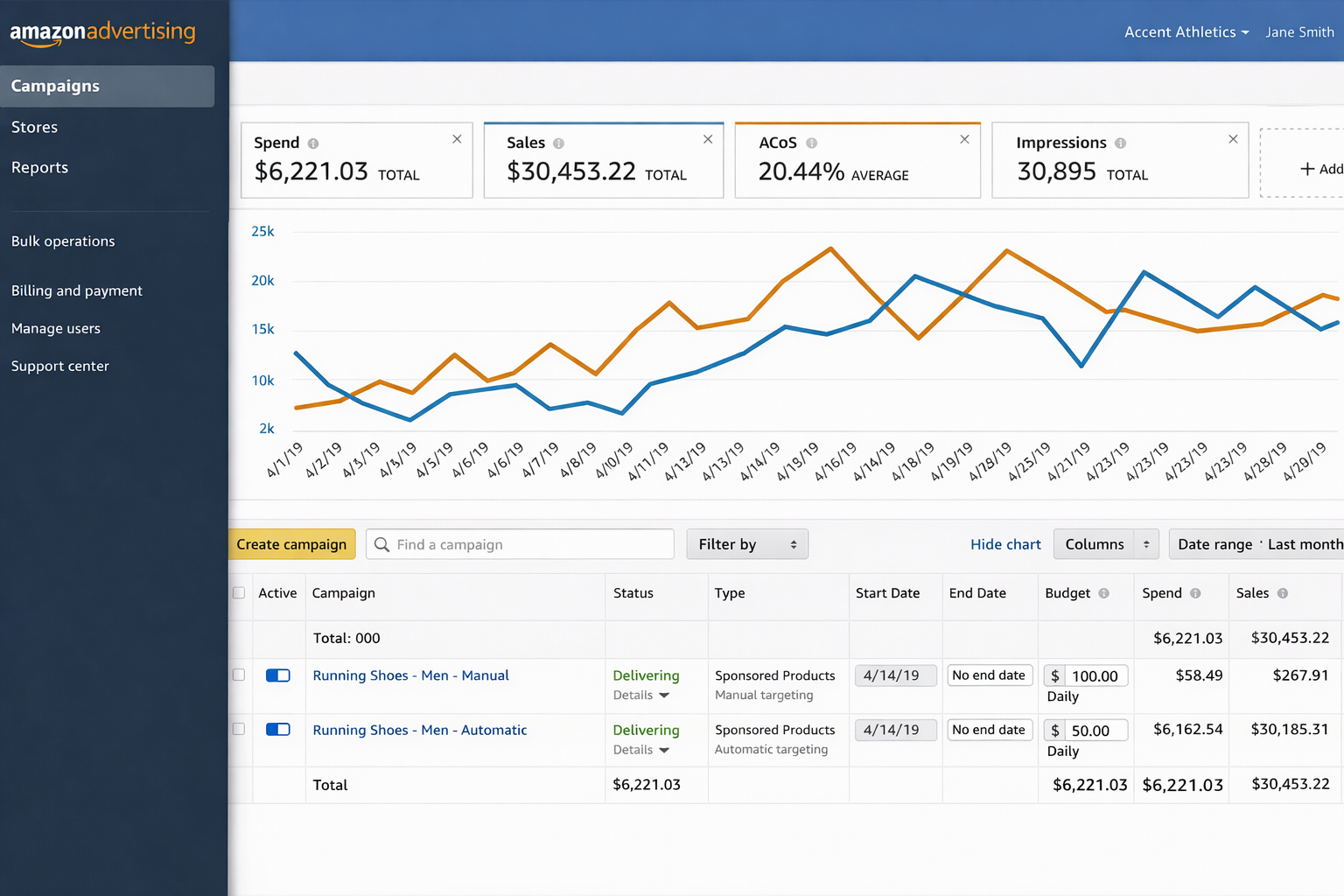
You can find ACoS on your Campaigns Dashboard. Simply click on the arrow next to your one of the metrics shown on your dashboard and there will be a drop down where you can select what KPI you want to display.
You can customize columns to show other metrics including:
- Spend
- Impressions
- Clicks
- CPC
ACoS vs. ROAS
ACoS and ROAS measure the same relationship from different perspectives.
Amazon emphasizes ACoS because it directly relates to margin control. However, some sellers may prefer ROAS because it frames performance in revenue terms.
For a deeper breakdown of ROAS benchmarks and strategy, check out this guide.
How to Calculate ACoS on Amazon
The formula for ACoS is: ACoS = (Ad Spend ÷ Ad Revenue) x 100%.
Take the following example:
- Ad Spend = $500
- Ad Revenue = $2,000
Step 1: Divide spend by revenue
$500 ÷ $2,000 = 0.25
Step 2: Multiply by 100%
0.25 x 100 = 25%
Your ACoS = 25%
What Is Break-Even ACoS?
Break-even ACoS is the maximum ACoS you can afford before losing money. This means it is the same as the product’s profit margin.
If your net margin after all Amazon fees, total cost of goods, and shipping and fulfillment costs equals 30%, then your break-even ACoS is 30%.
If your ACoS exceeds 30%, that means you’d lose money on ad-driven sales.
If your ACoS stays below 30%, you remain profitable.
Understanding this relationship is foundational to improving Amazon PPC ROI.
What Is Considered a Good ACoS on Amazon?
There is no universal “good” ACoS, but industry benchmarks provide context.
Common ACoS Benchmarks
In general, an ACoS under 25% is considered excellent and reflects strong advertising efficiency, while a range between 25% and 40% is typically viewed as average and sustainable for many sellers. An ACoS above 40% is generally considered high and may indicate the need to optimize your ad campaigns, unless you are intentionally prioritizing aggressive growth over short-term profitability.
When a Higher ACoS Makes Sense
ACoS targets vary depending on a seller’s strategic goals; generally, these goals fall into one of two categories: growth or efficiency.
Growth Strategy
- A Higher ACoS is acceptable
- Focus on increasing seller ranking and market share
- Allow for a short-term margin sacrifice
Efficiency Strategy
- Lower ACoS is required
- Focus is more on profitability
- Enhance keyword strategy and narrow it down to key performers
To improve Amazon ROI over time, your ACoS must fit within your profit margin and the long-term value of each customer.
For broader strategies on improving advertising efficiency and overall profitability, check out this blog.
Your Profit Margin is the True Context for ACoS
Two sellers can have the same ACoS and very different profitability outcomes because their individual profit margins determine the real impact.
Example
If both sellers run at a 35% ACoS but Seller A has a 50% margin, they remain profitable, while Seller B with a 30% margin loses money. This is why ACoS should always be evaluated against your own margins and not your competitors.
Ways to Lower Your ACoS (For Beginner and Advanced sellers)
Beginner’s Guide to Reducing ACoS
1. Adjust Keyword Bids
- Lower bids on high ACoS keywords
- Increase bids on low ACoS, high-converting terms
Focus on making bid adjustments based on performance data instead of gut feelings.
2. Refine Keyword and Product Targeting
- Focus on highly relevant search terms
- Remove loosely related keywords
- Prioritize exact and phrase match for efficiency
Higher relevance improves conversion rate, which lowers ACoS.
3. Pause or Remove Poor Performers
If a keyword:
- Has high spend
- Generates no sales
- Exceeds break-even ACoS
Pause it and preserve your funds for better performing keywords.
4. Optimize Product Listings
Your ad performance will only be as good as your listing quality.
Improve:
- Main image quality
- Bullet point descriptions
- A+ content
- Pricing competitiveness
- Increasing number of reviews and social proof
Higher conversion rate reduces ACoS because more clicks turn into sales.
Advanced Guide to Reducing ACoS
1. Prioritize Top-Performing ASINs
Allocate more budget toward products with:
- Stronger margins
- Higher conversion rates
Avoid spending your ad budget across underperforming ASINs.
2. Harvest Converting Search Terms
From auto-campaigns:
- Identify converting search terms
- Move them into manual, exact keyword campaigns
This improves Amazon PPC ROI through precision targeting.
3. Use Negative Keywords
Apply negative keywords in your ad campaigns to:
- Block irrelevant traffic
- Reduce wasted clicks
- Improve conversion efficiency
Every irrelevant click increases ACoS.
4. Allocate Budgets Around High-Conversion Periods (Dayparting)
Since different times of day can affect ad performance, whether by hour, day, or season, advanced sellers should:
- Increase bids during peak conversion windows
- Reduce exposure during low-intent periods
5. Isolate Underperforming Keywords
Instead of deleting underperforming keywords outright, you should try:
- Moving them into dedicated campaigns
- Test adjusted bids and monitor performance
While testing other keywords in a separate campaign, you ensure that no potential opportunities are missed.
6. Scale Strong Performers
ASINs with a low ACoS and high conversion rate indicates an opportunity to increase budgets for this ad group to:
- Capture more sales
- Improve organic rank
7. Organize Campaigns by Root Keyword Themes
Try applying a thematic structure to keywords to:
- Improve data clarity
- Simplify optimization
- Reduce overlap and increase efficiency
8. Optimize Ad Placements
Analyze performance of your ads across:
- Top of search
- Product pages
- Rest of search
Adjust ad placements based on ROI contribution.
BQool AI Advertising Solution to Lower ACOS
Basic and advanced ACoS optimization strategies require consistent oversight. For sellers with larger inventories, managing bids, budgets, and keywords daily becomes time-consuming.
Automation platform, such as AI-driven ad management tools, are commonly used to:
- Adjust bids dynamically
- Detect wasteful spend patterns
- Scale profitable keywords
- Optimize campaigns based on real-time performance
Try out BQool’s AI Advertising solution, designed to help sellers lower ACoS, increase sales and scale more profitably.
Below are some real seller case studies who benefited BQool’s advertising technology:
Conclusion
In conclusion, there is no single “good” ACoS that applies to every seller. It must reflect your margins, business goals, and stage of growth. Benchmarks can provide general guidance, but your break-even point should always anchor decision-making. Sustainable performance comes from balancing efficiency with growth, refining bids and targeting, improving conversion rates, and structuring campaigns intentionally. Advertising is most effective when supported by a strong product, competitive pricing, and a well-optimized listing. Ultimately, ACoS is a strategic variable you manage, but long-term profitability is the real measure of success.
FAQ
What is a good ACoS for Amazon?
A good ACoS on Amazon typically falls between 25% and 40%, depending on your profit margins and business goals. Sellers with higher margins can tolerate higher ACoS, while low-margin products require more control.
What is ACoS and how is it calculated?
ACoS (Advertising Cost of Sales) is the percentage of ad spend relative to ad-attributed revenue. It is calculated using the formula: Ad Spend/Ad Revenue x 100%.
Is a 30% ACoS good?
A 30% ACoS is good if your profit margin exceeds 30%. If your margin is lower than 30%, a 30% ACoS would result in a loss on ad-driven sales.
How does ACoS work?
ACoS works by measuring how much you spend on ads to generate revenue. Lower ACoS means higher advertising efficiency, while higher ACoS indicates more aggressive spending or lower conversion efficiency.
Amazon sellers often focus heavily on ACoS (Advertising Cost of Sales) because it directly measures Amazon advertising ROI at the campaign level. However, ACoS should never be evaluated in isolation. It’s a tactical metric that influences your broader strategy to improve Amazon profitability.
TL; DR
A good ACoS on Amazon depends on your profit margin, growth stage, and business goals, but in most cases, sellers aim for an ACoS between 25% and 40%. To improve Amazon ROI, your ACoS must stay below your break-even margin. If your profit margin is 35%, your ACoS must be lower than 35% to remain profitable. The right target balances growth and efficiency, not just lower ad spend.
Overview
- What Is Amazon ACoS?
- Why ACoS Is Important
- Where to Find ACoS in Seller Central
- ACoS vs. ROAS
- How to Calculate ACoS on Amazon
- What Is Break-Even ACoS?
- What Is Considered a Good ACoS on Amazon?
- Ways to Lower Your ACoS (For Beginner and Advanced sellers)
- BQool AI Advertising Solution to Lower ACOS
- Conclusion
- FAQ
What Is Amazon ACoS?
Amazon ACoS (Advertising Cost of Sales) is the percentage of ad spend relative to revenue generated from ads. Ad Spend is calculated as a percentage of Ad Revenue.
If you spend $20 on ads and generate $100 in ad-attributed sales, your ACoS is 20%.
Why ACoS Is Important
ACoS matters because it shows whether your ads are helping or hurting your profitability. If your ACoS is higher than your profit margin, you may generate sales but lose money, which would strain your cash flow since ads require upfront spending. A sustainable ACoS allows you to scale campaigns confidently, knowing increased ad spend will still be profitable. Ultimately, managing ACoS effectively ensures your advertising delivers strong ROI and supports long-term, sustainable growth on Amazon.
A lower ACoS indicates greater advertising efficiency, while a higher ACoS can reflect either aggressive growth investment or inefficient targeting. For experienced sellers, ACoS becomes a strategic tool, whereby lowering it prioritizes profitability and increasing it can accelerate growth when margins allow. The optimal target for experienced sellers should always align with your break-even threshold.
Where to Find ACoS in Seller Central
You can find ACoS on your Campaigns Dashboard. Simply click on the arrow next to your one of the metrics shown on your dashboard and there will be a drop down where you can select what KPI you want to display.
You can customize columns to show other metrics including:
- Spend
- Impressions
- Clicks
- CPC
ACoS vs. ROAS
ACoS and ROAS measure the same relationship from different perspectives.
Amazon emphasizes ACoS because it directly relates to margin control. However, some sellers may prefer ROAS because it frames performance in revenue terms.
For a deeper breakdown of ROAS benchmarks and strategy, check out this guide.
How to Calculate ACoS on Amazon
The formula for ACoS is: ACoS = (Ad Spend ÷ Ad Revenue) x 100%.
Take the following example:
- Ad Spend = $500
- Ad Revenue = $2,000
Step 1: Divide spend by revenue
$500 ÷ $2,000 = 0.25
Step 2: Multiply by 100%
0.25 x 100 = 25%
Your ACoS = 25%
What Is Break-Even ACoS?
Break-even ACoS is the maximum ACoS you can afford before losing money. This means it is the same as the product’s profit margin.
If your net margin after all Amazon fees, total cost of goods, and shipping and fulfillment costs equals 30%, then your break-even ACoS is 30%.
If your ACoS exceeds 30%, that means you’d lose money on ad-driven sales.
If your ACoS stays below 30%, you remain profitable.
Understanding this relationship is foundational to improving Amazon PPC ROI.
What Is Considered a Good ACoS on Amazon?
There is no universal “good” ACoS, but industry benchmarks provide context.
Common ACoS Benchmarks
In general, an ACoS under 25% is considered excellent and reflects strong advertising efficiency, while a range between 25% and 40% is typically viewed as average and sustainable for many sellers. An ACoS above 40% is generally considered high and may indicate the need to optimize your ad campaigns, unless you are intentionally prioritizing aggressive growth over short-term profitability.
When a Higher ACoS Makes Sense
ACoS targets vary depending on a seller’s strategic goals; generally, these goals fall into one of two categories: growth or efficiency.
Growth Strategy
- A Higher ACoS is acceptable
- Focus on increasing seller ranking and market share
- Allow for a short-term margin sacrifice
Efficiency Strategy
- Lower ACoS is required
- Focus is more on profitability
- Enhance keyword strategy and narrow it down to key performers
To improve Amazon ROI over time, your ACoS must fit within your profit margin and the long-term value of each customer.
For broader strategies on improving advertising efficiency and overall profitability, check out this blog.
Your Profit Margin is the True Context for ACoS
Two sellers can have the same ACoS and very different profitability outcomes because their individual profit margins determine the real impact.
If both sellers run at a 35% ACoS but Seller A has a 50% margin, they remain profitable, while Seller B with a 30% margin loses money. This is why ACoS should always be evaluated against your own margins and not your competitors.
Ways to Lower Your ACoS (For Beginner and Advanced sellers)
Beginner’s Guide to Reducing ACoS1. Adjust Keyword Bids
Focus on making bid adjustments based on performance data instead of gut feelings.
2. Refine Keyword and Product Targeting
Higher relevance improves conversion rate, which lowers ACoS.
3. Pause or Remove Poor Performers
If a keyword:
Pause it and preserve your funds for better performing keywords.
4. Optimize Product Listings
Your ad performance will only be as good as your listing quality.
Improve:
Higher conversion rate reduces ACoS because more clicks turn into sales.
|
Advanced Guide to Reducing ACoS1. Prioritize Top-Performing ASINs
Allocate more budget toward products with:
Avoid spending your ad budget across underperforming ASINs.
2. Harvest Converting Search Terms
From auto-campaigns:
This improves Amazon PPC ROI through precision targeting.
3. Use Negative Keywords
Apply negative keywords in your ad campaigns to:
Every irrelevant click increases ACoS.
4. Allocate Budgets Around High-Conversion Periods (Dayparting)
Since different times of day can affect ad performance, whether by hour, day, or season, advanced sellers should:
5. Isolate Underperforming Keywords
Instead of deleting underperforming keywords outright, you should try:
While testing other keywords in a separate campaign, you ensure that no potential opportunities are missed.
6. Scale Strong Performers
ASINs with a low ACoS and high conversion rate indicates an opportunity to increase budgets for this ad group to:
7. Organize Campaigns by Root Keyword Themes
Try applying a thematic structure to keywords to:
8. Optimize Ad Placements
Analyze performance of your ads across:
Adjust ad placements based on ROI contribution.
|
BQool AI Advertising Solution to Lower ACOS
Basic and advanced ACoS optimization strategies require consistent oversight. For sellers with larger inventories, managing bids, budgets, and keywords daily becomes time-consuming.
Automation platform, such as AI-driven ad management tools, are commonly used to:
- Adjust bids dynamically
- Detect wasteful spend patterns
- Scale profitable keywords
- Optimize campaigns based on real-time performance
Try out BQool’s AI Advertising solution, designed to help sellers lower ACoS, increase sales and scale more profitably.
Below are some real seller case studies who benefited BQool’s advertising technology:
Conclusion
In conclusion, there is no single “good” ACoS that applies to every seller. It must reflect your margins, business goals, and stage of growth. Benchmarks can provide general guidance, but your break-even point should always anchor decision-making. Sustainable performance comes from balancing efficiency with growth, refining bids and targeting, improving conversion rates, and structuring campaigns intentionally. Advertising is most effective when supported by a strong product, competitive pricing, and a well-optimized listing. Ultimately, ACoS is a strategic variable you manage, but long-term profitability is the real measure of success.
FAQ
What is a good ACoS for Amazon?
A good ACoS on Amazon typically falls between 25% and 40%, depending on your profit margins and business goals. Sellers with higher margins can tolerate higher ACoS, while low-margin products require more control.
What is ACoS and how is it calculated?
ACoS (Advertising Cost of Sales) is the percentage of ad spend relative to ad-attributed revenue. It is calculated using the formula: Ad Spend/Ad Revenue x 100%.
Is a 30% ACoS good?
A 30% ACoS is good if your profit margin exceeds 30%. If your margin is lower than 30%, a 30% ACoS would result in a loss on ad-driven sales.
How does ACoS work?
ACoS works by measuring how much you spend on ads to generate revenue. Lower ACoS means higher advertising efficiency, while higher ACoS indicates more aggressive spending or lower conversion efficiency.