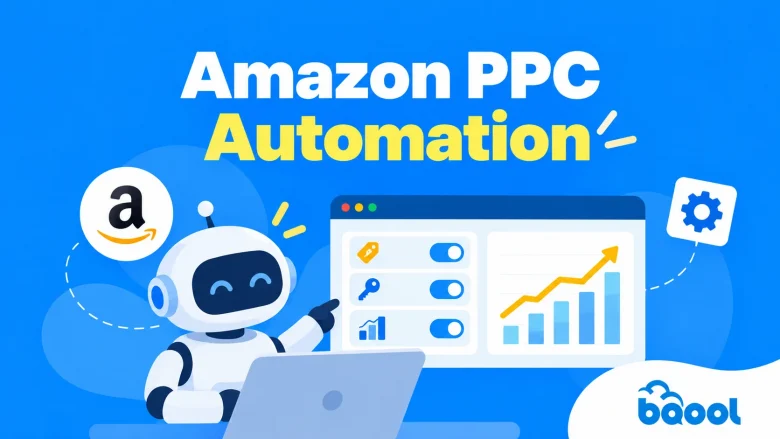
Amazon PPC automation can save hours of repetitive work. But that does not mean you should automate everything at once.
Bids, search terms, negatives, budgets, reporting, and time-based adjustments can all be automated to some degree. The real question is where to start.
A useful rule is:
Start with work that is repetitive, data-driven, and easy to monitor.
Build visibility first. Then automate repeatable execution. Add more automation only when the data and business context are clear.
This guide explains which Amazon PPC tasks are usually the best candidates for automation, which ones should come later, and which decisions still require human judgment.
Notes: Automation is only one part of improving campaign performance. If results are weak, use a broader Amazon PPC optimization process to determine whether the real issue is traffic, bids, budget, or conversion.
Overview
- What Does Amazon PPC Automation Mean?
- How to Decide What to Automate
- Start With Visibility: Reporting & Monitoring
- 1. Automate Bid Management First
- 2. Automate Target Harvesting and Negative Targeting Together
- 3. Automate Budget Management Once Priorities Are Clear
- 4. Add Time-Based Automation Later
- What Should Stay Under Human Control?
- When Should You Wait Before Automating?
- A Simple Amazon PPC Automation Roadmap
- How to Know Whether Your Automation Is Working
- Automate Amazon PPC Workflows with BQool Advertising
- Key Takeaway
- FAQ
What Does Amazon PPC Automation Mean?
Amazon PPC automation means using software, rules, algorithms, or AI to handle recurring advertising tasks that would otherwise require manual review or changes.
That may include:
- Adjusting bids
- Finding new keyword or product targets
- Adding negative targets
- Managing budgets
- Monitoring performance
- Creating campaigns
- Preparing reports
- Using time-based performance signals
Automation does not mean handing over your entire advertising account.
A better way to think about it is:
You define the goal. Automation helps execute repeatable decisions.
If you are still comparing tools rather than deciding what to automate, see our guide to choosing Amazon PPC software.
How to Decide What to Automate
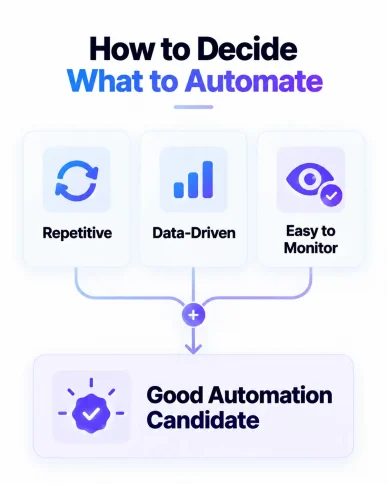
Before turning automation on, evaluate the task using three questions.
Is It Repetitive?
Do you perform the same type of review or adjustment again and again?
If the process rarely changes, automation may save meaningful time.
Is It Data-Driven?
Can the decision be made mostly from measurable campaign data?
Tasks that rely on clear performance signals are usually easier to automate than decisions that depend heavily on business judgment.
Is It Easy to Monitor?
Can you see what changed and determine whether the automation is working?
If automated actions are difficult to review, it becomes harder to know whether they are helping.
The strongest automation candidates usually meet all three conditions:
Repetitive → Data-driven → Easy to monitor
Start With Visibility: Reporting & Monitoring
Before automating campaign decisions, make sure you can clearly see what is happening.
Instead of repeatedly exporting data, combining spreadsheets, and checking campaigns one by one, PPC software can help centralize:
- Spend and sales
- ACoS or ROAS
- Campaign performance
- Target performance
- Historical trends
- Recent changes
This is especially useful if you regularly report results to managers, clients, or other teams. The value is not only saving reporting time. Better visibility makes it easier to decide what to automate next.
1. Automate Bid Management First
Once your campaign goals are clear, bid management is often the best place to start automating execution.
A single bid change is simple. The challenge is repeating that decision across hundreds or thousands of keyword and product targets.
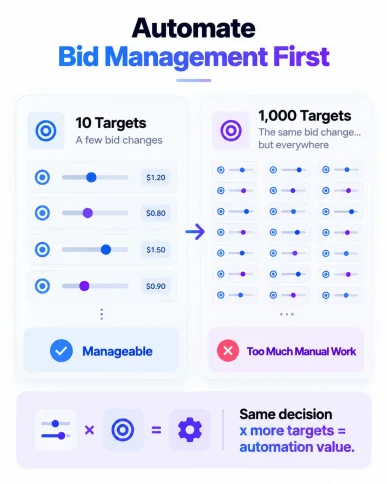
Bid automation is especially useful when:
- You manage many active targets
- Bid reviews take significant time
- Performance changes frequently
- Campaigns have clear efficiency goals
Before automating bids, define your:
- Campaign objective
- Target ACoS or efficiency goal
- Product margins
- Minimum data requirements
Automation can make bid execution more consistent. It cannot decide what a healthy advertising outcome means for your business.
Before automating bids, make sure your campaign objective and efficiency target are clear. If you are still working out how bid decisions should work, start with our Amazon bidding strategy guide.
2. Automate Target Harvesting and Negative Targeting Together
Campaign data tells you two important things:
- What traffic do you want more of?
- What traffic should you stop paying for?
These decisions belong to the same optimization loop.
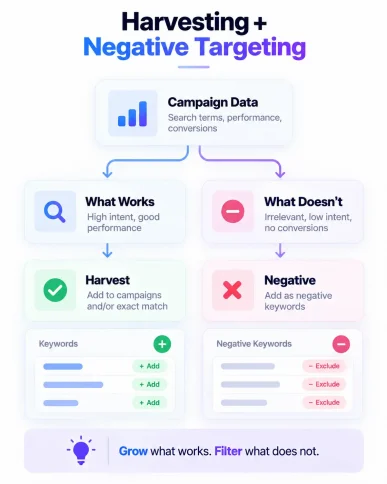
Harvesting: Find What Works
Search terms and product interactions may reveal opportunities that were not part of your original targeting strategy.
Automation can help identify:
- Search terms worth targeting
- New keyword opportunities
- Product-target opportunities
The goal is to turn useful campaign data into new targeting opportunities without manually reviewing every search term.
Search-term data is one of the main places to find new targeting opportunities. Learn how to analyze your Amazon Search Term Report before deciding what to harvest.
Negative Targeting: Filter What Does Not
The same data can also reveal traffic that repeatedly spends without contributing enough value.
Automation can help identify:
- Poor-performing search terms
- Irrelevant traffic
- Negative keyword opportunities
- Negative product-target opportunities
Negative targeting deserves more caution because blocking the wrong traffic can remove future opportunities.
3. Automate Budget Management Once Priorities Are Clear
Budget automation becomes more useful when many campaigns compete for limited advertising spend.
Consider two campaigns:
- Campaign A performs well but regularly runs out of budget.
- Campaign B spends its full budget but performs poorly.
Giving both campaigns more money does not make sense.
Budget automation can help shift spending toward stronger campaigns but only after you know which campaigns matter, which are efficient, and how much you are willing to spend.
4. Add Time-Based Automation Later
Campaign performance may vary by day of week or time of day. PPC Software can use these patterns as another signal for bid decisions.
But dayparting should rarely be the first thing you automate.
Because time-based patterns need enough historical data to separate meaningful behavior from normal performance variation. A few strong evenings do not necessarily mean evenings are always better.
Time-based automation becomes more useful when:
- Campaigns have enough historical data
- Core bidding is already under control
- Performance patterns appear consistently
- Time is actually influencing results
What Should Stay Under Human Control?
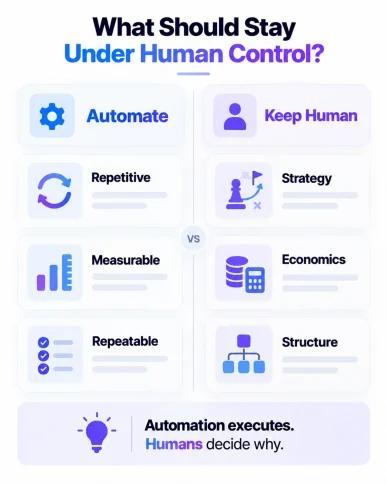
Automation works best when decisions can be repeated using clear inputs.
Some decisions depend too heavily on business context to hand over completely.
Campaign Goals and Strategy
PPC Software should not decide why a campaign exists.
You still need to define whether the goal is discovery, growth, profitability, brand defense, or another business objective.
Similar performance can require different actions when campaign goals differ.
Product Economics
Advertising decisions should reflect margins, fees, pricing, promotion, inventory, and break-even economics.
A bid that looks efficient from an advertising perspective may still be wrong for the business.
Major Structural Decisions
Large changes to campaign structure, targeting strategy, or account segmentation still require human judgment.
Automation can execute the structure. Humans should decide why it exists.
When Should You Wait Before Automating?
Wait when the data is too limited or no longer reflects current conditions, such as:
- New campaigns or products
- Low-volume targets
- Recent price or promotion changes
- Sudden seasonal shifts
Automation cannot create reliable signals from data that does not exist yet.
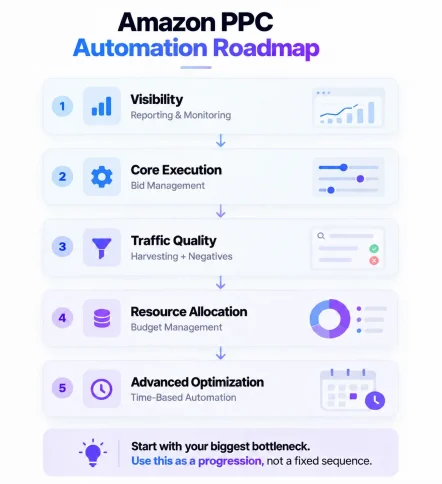
A Simple Amazon PPC Automation Roadmap
A practical progression may look like this:
- Visibility: Reporting & Monitoring
- Core Execution: Bid Management
- Traffic Quality: Harvesting + Negatives
- Resource Allocation: Budget Management
- Advanced Optimization: Time-Based Automation
You do not need to follow this exact sequence for every account.
Turning automation on is only the beginning. You also need to know whether it is actually making PPC management better.
How to Know Whether Your Automation Is Working
Two questions matter most.
Is Repetitive Work Actually Decreasing?
Automation should reduce the time spent on recurring reviews, updates, and reporting.
Can You Still Understand and Control What Changes?
You should be able to see what the system changed and step in when needed.
Performance still matters, but do not judge automation by a single metric. Pricing, competition, conversion, inventory, and seasonality can all affect results.
The broader question is:
Is automation making campaign management more consistent without taking away the control you need?
Automate Amazon PPC Workflows with BQool Advertising
BQool Advertising supports different stages of this workflow:
| Automation Stage | BQool Advertising |
|---|---|
| Visibility | Dashboard & Reporting |
| Bid Execution | AI-Bidding |
| Targeting Loop | AI-Harvesting |
| Budget Allocation | Auto Budgeting |
| Campaign Setup | Campaign Builder |
| Transparency | Ad History |
Together, these tools help automate recurring execution while keeping campaign strategy under your control.
Key Takeaway
Do not automate everything at once.
Build visibility first. Automate repetitive execution next. Expand only when the data supports it.
Keep strategy, economics, and major account decisions under human control.
FAQ
What is Amazon PPC automation?
Amazon PPC automation uses software, rules, algorithms, or AI to handle recurring advertising tasks such as bid adjustments, targeting, budgets, monitoring, and reporting.
What should I automate first in Amazon PPC?
Start with visibility through reporting and monitoring. Once campaign goals are clear, bid management is often the first high-value execution task to automate.
Should I automate Amazon PPC bids?
Bid automation can be useful when you manage many targets and have clear campaign goals, efficiency targets, and enough performance data to support decisions.
Can Amazon PPC automation add negative keywords?
Some tools can identify and add negative keywords or product targets based on campaign data. Negative automation should use enough data and appropriate guardrails to avoid excluding useful traffic too early.
When should I automate Amazon PPC budgets?
Budget automation makes more sense once campaign priorities are clear and you understand which campaigns deserve more spending capacity.
Can Amazon PPC be fully automated?
Many recurring tasks can be automated, but strategy, product economics, major structural decisions, and situations with limited data still benefit from human judgment.