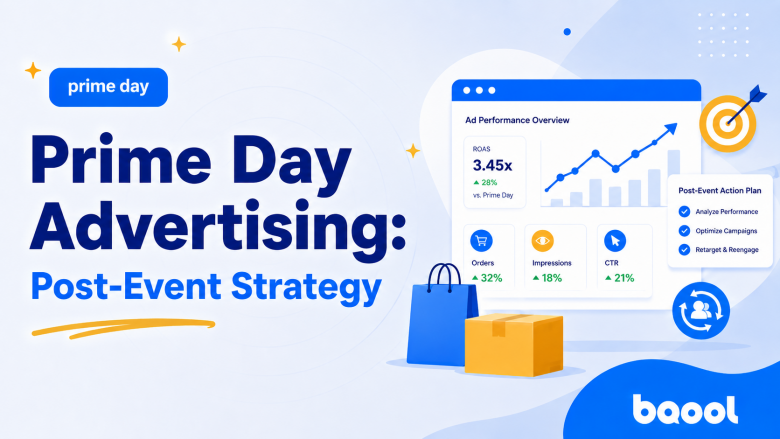
The biggest event of the year is over, but that doesn’t mean your Prime Day advertising strategy should end too. Post-Prime Day presents one of the most advantageous moments for sellers, where your ad budgets shift from a more aggressive, impression-driven approach to one that is more focused on profit, retargeting, and customer retention.
In this article, we guide you through how to navigate the post-peak environment on Amazon and how to tweak your Ads strategy for this period.
Overview
Quick Answer
Review your Prime Day data to identify which products and search terms have the potential to produce more sales even after your Prime Day promotions have ended. Keep high-performing campaigns live, reduce bids on search terms where conversions are dropping, and redirect ad spend toward high-intent audiences and moving products.
What Changes After Prime Day on Amazon Marketplace?
After Prime Day, shopper behavior does not “return to normal” the moment Prime Day ends. Many customers spend the event comparing products, reading reviews, visiting newly discovered storefronts, or saving products for later rather than buying immediately, allowing them to make a more considered purchase.
According to Digital Commerce 360, this is called the Prime Day “halo effect” where traffic and the increase in visits from shoppers during the event continue even after the deal window closes. For advertisers, this means that while post-event traffic may be smaller, it can be more qualified. Customers who have already interacted with your product page or brand are no longer cold prospects.
How Should Your Advertising Goals Change After Prime Day?
After Prime Day, focus more on which ads are helping you make sales instead of which ads are only getting lots of views. Impressions and clicks still matter, but they should not be the primary reason to keep spending. Your focus now should be on removing the search terms that gathered clicks but did not bring in any sales, reducing wasted ad spend.
What Should Sellers Adjust Their Amazon Ads Strategy After Prime Day?
1. Download and Review Your Search Term Report
The first thing sellers should do after Prime Day is over is download your search term report. The most valuable time to download this report is right after Prime Day ends or during the following week. Once you have this report in your hands, review which keywords, products, and campaigns generated sales and which ones only drove clicks.
2. Scale, Reduce, or Pause Campaigns
From there, organize your existing campaigns into two groups:
- Scale: Campaigns that maintained strong conversion and acceptable profitability during and after the event.
- Reduce or pause: Campaigns that generated clicks without meaningful orders, cross-sales, or customer acquisition value.
According to Innel’s Post-Prime Day Analysis, sellers who saw improved ACoS from their campaigns were the ones that allocated the majority of their ad spend toward their top 10 converting keywords. Exact-match structured campaigns protected traffic that proved to have higher conversions, rather than evenly distributing ad spend across campaigns that had a mix of low- and high-converting keywords.
Once you have identified those high-converting keywords, consider moving them into dedicated exact-match campaigns and allocating more budget toward them. At the same time, reduce bids or pause search terms that gathered clicks but did not bring in sales.
3. Adjust Bids Gradually After Prime Day
After deciding which campaigns to scale, reduce, or pause, adjust your bids carefully. The advertising auction may become less crowded after Prime Day. Some sellers dramatically reduce budgets once promotions expire, while others pause campaigns that were built only for product deals. That does not guarantee lower CPCs, but it can create room for advertisers to maintain visibility on profitable terms rather than competing for maximum reach.
If you plan to reduce your ad spend to pre-Prime Day rates, gradually decrease bids over a 5–7-day period rather than making sudden cuts.
This can help you manage ad spend while maintaining organic rankings. Keep monitoring conversion rates, CPCs, and ACoS during this period so you can protect profitable search terms and reduce spend on terms that are no longer converting.
4. Retarget Shoppers and Cross-Sell to Customers
After adjusting your existing campaigns and bids, the next step is to focus on shoppers who interacted with your products during Prime Day but did not purchase. Product viewers are often the highest-priority segment because they have already shown direct interest in a specific ASIN.
Brand-registered sellers can create Brand-Tailored Promotions to target shoppers who showed prior interest in a product through the “re-engagement” goal setting for this campaign. In the messaging, use clearer value framing or product proof, while Store visitors may need a category-led message that helps them choose among related products.
Finally, do not overlook customers who did purchase during Prime Day. You can target customers who purchased your product through a Brand-Tailored Promotion with a “cross-sell” goal. Examples of these promotions include:
- Cross-sells that solve the next logical need.
- Bundles that increase product utility.
- Refills or replenishments for consumable categories.
- Complementary products that extend the original purchase.
Additionally, Amazon’s purchased-product reports can help identify non-advertised ASINs customers buy after clicking an ad, making them useful for finding cross-sell relationships and bundle opportunities.
How to Use Prime Day Insights for a Solid Q3 Strategy
The insights gathered during Prime Day can be repeated and applied to future events like back-to-school, Black Friday and Cyber Monday, and even end-of-year holidays.
Use the following insights to shape your next event strategy:
- High-converting keywords: Review your search term report and sort keywords by orders, conversion rate, and ACoS. Move consistently high-converting terms into dedicated exact-match campaigns and assign enough budget to prevent those campaigns from running out during peak shopping periods.
- Top-performing products: Identify the ASINs that generated the strongest conversion rates, profitable sales, and sustained demand after Prime Day. Feature these products more prominently in future campaigns and make sure inventory, pricing, and listing content are ready before the next event.
- Campaign performance: Separate campaigns into “scale,” or “pause” groups. Increase budgets for profitable campaigns and pause search terms or targets that generated clicks without meaningful sales.
- Bid strategy: Review how CPCs and conversion rates changed during and after Prime Day. Set event-period bids based on the terms that remained profitable, then gradually reduce bids after the event instead of making sudden cuts that could affect organic visibility.
- High-intent audiences: Create campaigns for shoppers who viewed your products, visited your Store, or engaged with your brand but did not purchase. Use product-specific messaging, reviews, value propositions, or category comparisons to encourage them to return.
- Cross-sell opportunities: Review purchased-product reports to identify products customers bought alongside or after clicking on your ads. Use these insights to create bundles, promote complementary ASINs, or target recent buyers with relevant follow-up products.
- Winning creative: Record which product images, headlines, value messages, and proof points generated the strongest engagement or conversion. Remove expired deal messaging and reuse effective product-focused creative in future campaigns.
- Baseline comparisons: Measure Prime Day and post-event performance against a pre-event baseline. Review changes in sales, TACoS, conversion rate, new-to-brand customers, and organic ranking to determine which gains were sustainable and which were driven mainly by promotions.
After gathering these insights, save your best keywords, products, audiences, bid ranges, and creative ideas in one file. This gives you a clear starting point for your next sales event instead of rebuilding your strategy from scratch.
Dedicated ad-management platforms can also help make this process more consistent by helping you monitor bids, budgets, search terms, and campaign rules over time.
BQool AI Advertising is one example of a platform that uses AI bidding and AI keyword harvesting to support bid management, budget monitoring, keyword discovery, and campaign structuring in one workflow. Using automation can help reduce manual adjustments and keep your Amazon advertising strategy moving even after Prime Day.